Learn what tile water absorption percentages and BIa–BIII ratings mean, how they are tested, and why a low result does not prove every application.
Water absorption is one of the first figures buyers see on a ceramic or porcelain tile specification sheet. It helps classify the fired tile body, but it does not confirm every aspect of product performance. A low percentage cannot, by itself, prove that a tile is suitable for an exterior facade, a wet floor, a swimming pool or a high-traffic commercial space.
This guide explains what the percentage measures, how the common BIa–BIII groups are organised and what the 0.5% porcelain threshold means. For project-specific decisions, read our guide to using tile water absorption ratings in wet, exterior and commercial projects.
The short answer
Tile water absorption is the increase in a specimen’s mass after water enters its accessible pores under a defined laboratory procedure. The result is expressed as a percentage of the dry mass:
Water absorption (%) = (saturated mass − dry mass) ÷ dry mass × 100
A lower result normally indicates a denser, less absorptive ceramic body. The figure is useful for product classification and specification review. It is not a complete measure of wear resistance, breaking strength, slip-related performance, stain resistance, frost resistance or waterproofing.
How tile water absorption is tested
The test method matters as much as the number. ISO 10545-3 describes an international method for determining water absorption, apparent porosity, apparent relative density and bulk density. In North America, ASTM C373-18(2023) covers water absorption and associated properties for ceramic and glass tiles.
The laboratory dries and weighs the specimens, exposes them to water using the stated procedure, removes surface moisture and records the saturated mass. Buyers should not compare two percentages until they have confirmed the test method, product identity, sample preparation and report date.
Tile water absorption classification table
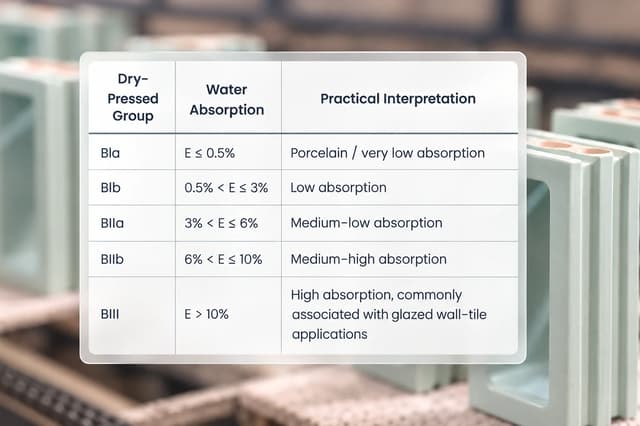
ISO 13006 classifies ceramic tiles by forming method and water absorption. The letter B identifies dry-pressed tiles. The following groups are commonly used for dry-pressed ceramic products:
| Group | Measured water absorption | Practical reading |
|---|---|---|
| BIa | E ≤ 0.5% | Very low absorption; commonly classified as porcelain |
| BIb | 0.5% < E ≤ 3% | Low absorption |
| BIIa | 3% < E ≤ 6% | Medium-low absorption |
| BIIb | 6% < E ≤ 10% | Medium-high absorption |
| BIII | E > 10% | High absorption; often associated with glazed interior wall tile |
E is the measured water absorption percentage. Extruded tiles use group names beginning with A, so the forming method must be checked before interpreting the classification.
The table is not a universal installation approval chart. A BIII glazed wall tile may be appropriate for an interior vertical surface, while a BIa porcelain tile still needs the correct surface, strength, fixing system and declared area of use.
What does the 0.5% porcelain threshold mean?
In commonly referenced international and North American definitions, porcelain tile has a water absorption result of 0.5% or less under the applicable test method. The threshold gives buyers an objective way to distinguish a very low-absorption body from more absorptive ceramic groups.
It does not mean that every porcelain product can be installed anywhere. Porcelain classification does not automatically establish wet-floor suitability, exterior use, resistance to freeze-thaw cycling, commercial wear performance or the waterproofing of the completed assembly. Those questions require separate product declarations, test evidence and installation design.
For a broader material comparison, see Porcelain vs Ceramic Tile: How to Choose the Right Product.
Is lower water absorption always better?
No. Lower absorption is important when a specification requires a dense body or a particular classification. It is not a general quality score.
A glazed ceramic wall tile can be suitable for a kitchen or bathroom wall even when its body absorbs more water than porcelain. A low-absorption floor tile can still be unsuitable for a wet area if its surface-use information, drainage requirements or installation conditions do not match the project. The correct question is: Does the exact product meet every requirement of the intended application?
Buyers looking for vertical interior products can compare indoor tile collections and small-format subway tiles, then confirm the technical data for the selected model.
How to read a supplier test report
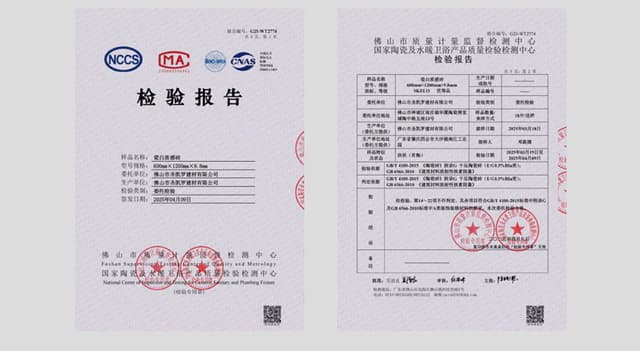
Before accepting a reported absorption value, check:
- The product code, body and size match the item being purchased.
- The report names the test method and edition used.
- The specimens and test date are clearly identified.
- The stated group agrees with the measured result.
- The report comes from an appropriate laboratory or documented factory test process.
- Other required properties are reported separately.
An isolated percentage copied into a catalogue is weaker evidence than a traceable report linked to the exact model and production specification.
Common mistakes
- Treating “porcelain” as proof of every application.
- Using water absorption as a slip-resistance rating.
- Assuming tile and grout make a wet area waterproof.
- Comparing results produced by different methods without checking the reports.
- Accepting a report that cannot be matched to the ordered product.
- Selecting the lowest number before defining the project conditions.
Frequently asked questions
What is a good water absorption rate for tile?
There is no single best rate for every tile. The required classification depends on the product type, applicable standard and intended use. Start with the application, then identify the necessary evidence.
Does porcelain tile absorb water?
Yes. Porcelain is very low absorption, not necessarily zero absorption. It is commonly defined by a measured result of 0.5% or less.
Is a low-absorption tile automatically frost resistant?
No. Low absorption can be relevant to exterior selection, but frost resistance must be confirmed through the appropriate product declaration and test evidence for the destination market.
Can a high-absorption tile be used in a bathroom?
It may be suitable for a declared interior wall application. Bathroom floors, showers and other wet areas require evaluation of the complete tile and installation system.
Join the discussion
Your email address will not be published. Required fields are marked.