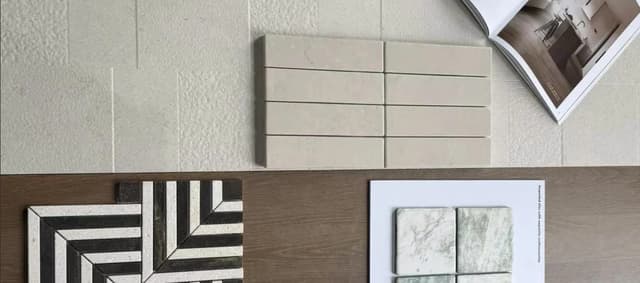
Compare porcelain and ceramic tile by water absorption, strength, wear, finish and installation, and understand what the 0.5% porcelain threshold means.
Porcelain and ceramic tile are often presented as competing materials, but porcelain is actually one type of ceramic tile. The useful question is not which label sounds better. It is how the tested product differs in water absorption, strength, surface performance, installation and intended use.
This guide explains the main differences so buyers, designers and project teams can compare products using evidence instead of assumptions.
The short answer
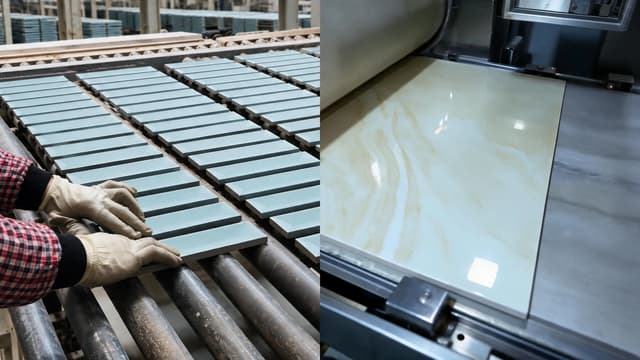
Porcelain tile is generally denser and has very low water absorption. Under the ANSI definition summarized by the Tile Council of North America (TCNA), porcelain tile absorbs 0.5% water or less when tested using the applicable method. Other ceramic tiles absorb more than 0.5%.
That threshold is important, but it is not a complete performance ranking. A tile still needs the correct strength, wear, surface and installation characteristics for its intended use.
Is porcelain tile ceramic tile?
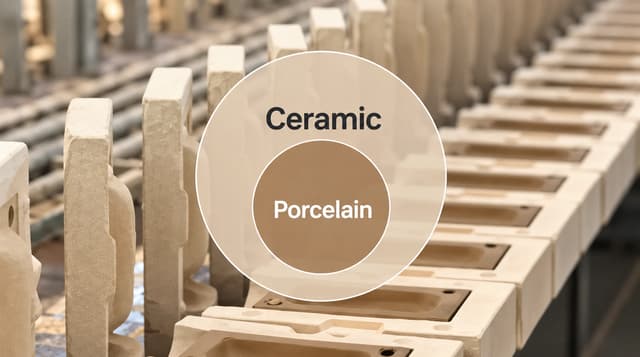
Yes. Ceramic tile is the broad family of products made from inorganic materials and fired at high temperature. Porcelain belongs within that family.
The distinction is based on defined product characteristics, not appearance alone. ISO 13006:2018 establishes ceramic-tile definitions, classifications, characteristics and marking requirements. For the North American definition, TCNA explains that porcelain has water absorption of 0.5% or less and non-porcelain tile has absorption above 0.5%.
Colour, weight and the look of a broken edge may offer clues, but they do not replace a product-specific test report.
Porcelain vs ceramic tile comparison
| Selection factor | Porcelain tile | Other ceramic tile |
|---|---|---|
| Water absorption | 0.5% or less under the applicable definition and test | Above 0.5%, across several classifications |
| Body | Commonly dense and fine-grained | Varies widely by formulation and process |
| Typical use | Floors, walls and selected demanding applications | Walls, floors and decorative applications, depending on the model |
| Cutting and bonding | May require more capable tools and appropriate mortar | Often easier to cut and handle |
| Surface options | Glazed, unglazed, polished, matt and textured | Broad glazed, matt, glossy and decorative ranges |
| Final decision | Verify the exact specification | Verify the exact specification |
The table describes common tendencies. It cannot certify an individual product.
1. Water absorption
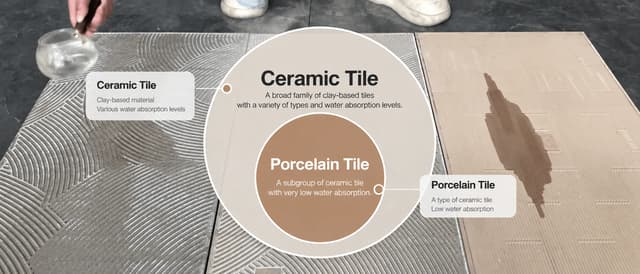
Water absorption measures how much water enters accessible pores during a specified laboratory test. ASTM C373 covers water-absorption and related measurements for ceramic and glass tile. The current ASTM listing identifies ASTM C373-18(2023) as active.
Low absorption helps define porcelain and can support decisions for wet or freeze-thaw exposure. It does not establish slip performance, breaking strength, wear resistance or waterproofing of the completed assembly. For a fuller explanation, read Tile Water Absorption Ratings Explained.
2. Strength and floor suitability
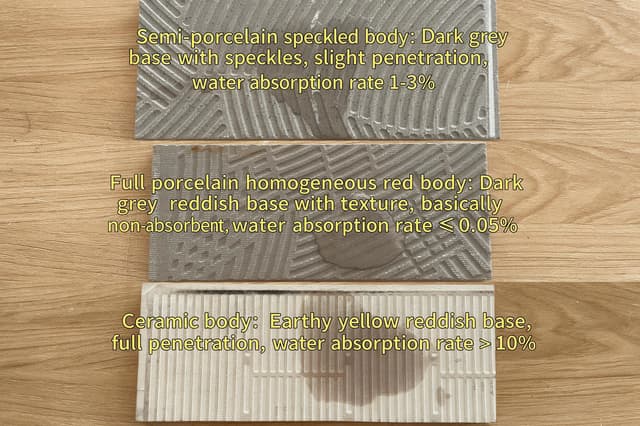
Porcelain products are often selected for floors because their dense bodies can support demanding applications. However, the word “porcelain” does not prove that every model is suitable for every floor.
Check breaking strength or breaking load, thickness, format, substrate, traffic and installation conditions. A ceramic product with suitable test data may be a valid floor tile, while a decorative wall tile should not be moved to the floor because it looks similar.
3. Surface wear
For glazed products, traffic acts on the glaze first. Buyers should therefore review the manufacturer’s declared area of use and relevant surface-abrasion information. Unglazed products use different wear measures.
A dense body cannot compensate for a surface that is unsuitable for the expected traffic, cleaning routine or contaminants.
4. Finish and wet-use selection
Matt, polished, textured and glazed finishes change appearance and maintenance. They can also affect how the surface behaves underfoot.
Porcelain is not automatically slip resistant. TCNA’s DCOF guidance explains that hard-surface flooring needs product-use classification and that slip risk depends on more than one laboratory value. Review the exact finish, slope, drainage, contaminants and maintenance plan.
5. Design and product range
Both categories can reproduce stone, marble, concrete, wood and handmade effects. Ceramic wall tiles may offer colour, relief and decorative formats that are well suited to vertical applications. Porcelain ranges often include floor formats and coordinated indoor or outdoor options.
Choose the look after confirming that the product meets the technical brief. Browse Ceraglow’s indoor tile range to compare current formats and finishes.
6. Installation
Porcelain may be harder to cut and bond because of its dense body. Large formats also increase demands on substrate flatness, handling, adhesive coverage and movement-joint planning. Other ceramic tiles can be easier to cut, but each product still requires an appropriate installation system.
Confirm the tile size, thickness, backing, substrate, adhesive, grout and local installation requirements before ordering.
Common myths
Is porcelain always better than ceramic tile?
No. Porcelain is useful when its low absorption and other verified characteristics match the application. A suitable ceramic wall tile can be the more practical choice for an interior wall.
Is porcelain waterproof?
Porcelain has very low water absorption, but the complete installation includes joints, substrate, membrane, penetrations and drainage. Tile alone does not waterproof an assembly.
Can appearance identify porcelain?
Not reliably. Request the product classification and test evidence.
What should you compare next?
After understanding the material difference, select by application. Our related guide, Porcelain or Ceramic Tile: How to Choose by Application, covers walls, residential floors, showers, commercial floors and exterior areas.
If you are sourcing for distribution, private label or a construction project, send Ceraglow the destination market, intended use, size, finish and expected quantity. We can help identify the product information and test evidence relevant to your enquiry.
Written by Ceraglow Product R&D Department. Reviewed by Ceraglow Content Review Department.
Join the discussion
Your email address will not be published. Required fields are marked.