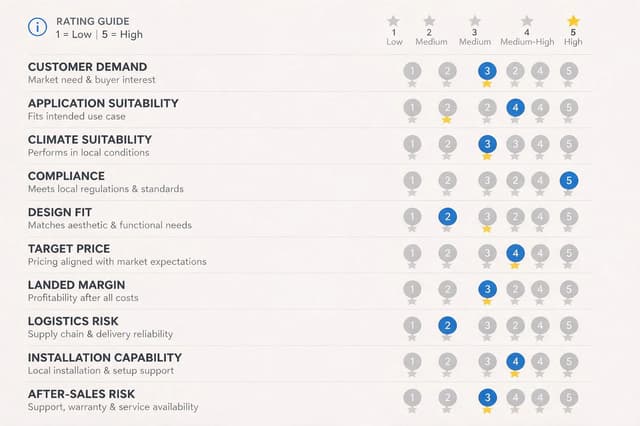
Turn local demand into a controlled tile assortment using application briefs, compliance checks, landed cost, price architecture, samples and a pilot launch.
Market research identifies what customers may buy. An assortment plan decides which products the business can specify, import, stock, explain and replenish reliably.
The strongest range is rarely the largest. It combines a dependable core with selected points of difference, covers priority applications and keeps inventory, compliance and supply risk under control. This guide shows how to build that range before committing to a container or private-label programme.
Translate each opportunity into a product brief
Begin with the market opportunity statements created through customer, channel and competitor research. If that work is not complete, read How to Research Tile Demand in Your Local Market.
For each proposed item, define:
- target customer and application;
- tile type and forming method;
- declared wall, floor, interior, exterior, wet or other use;
- size, thickness, edge, surface, colour and shade variation;
- required strength, wear and surface-use information;
- packaging, label, barcode and language requirements;
- reports, declarations and shipment records;
- target landed cost, selling price and margin;
- initial quantity and replenishment plan.
This prevents a sales term such as premium porcelain from becoming the entire purchase specification.
1. Confirm destination-market requirements
Compliance is market-specific and changes over time. Identify the legal framework, product standard, test methods, declarations, labels, importer duties, languages and record-retention requirements that apply on the date the product is placed on the market.
ISO 13006:2018 defines and classifies ceramic tiles and establishes characteristics and marking requirements. The ISO 10545 series contains related test methods. A destination market may adopt, modify or supplement this framework.
For the European Union, the current Construction Products Regulation transition and applicable harmonised technical specification must be checked. European Commission guidance explains that CE marking follows the required assessment, declaration and technical documentation process; a mark is not a universal approval for every use or country.
Great Britain maintains a separate construction-products regime and continues to recognise CE marking under current government policy. Northern Ireland has different arrangements. Verify the official Great Britain guidance again before publication, ordering and shipment.
North American project documents may reference ANSI and ASTM standards. TCNA lists ANSI A137.1-2022 as the current American National Standard Specification for Ceramic Tile. Confirm the project specification and applicable federal, state, provincial or local requirements separately.
2. Match the product to the application
A compliant document set does not replace application review. Separate interior walls, residential floors, wet areas, commercial floors, exterior areas, facades and pools.
For each application, identify the evidence that matters. Floors may require strength, wear and surface-use information. Exterior projects add climate, drainage, movement and freeze-thaw questions. Pools require confirmation of the full immersed system. Use the wall and floor application guide to structure this review.
3. Build a focused core and controlled differentiation
A practical opening assortment can include:
- a neutral core with repeat demand;
- wall and floor options mapped to the leading applications;
- a limited format plan compatible with local handling;
- selected distinctive designs that give dealers a reason to show the range;
- samples and display boards for priority channels;
- spare stock for projects, claims and later repairs.
Remove near-duplicates that serve the same customer, use and price. Every item should have a clear role: volume, margin, application coverage or differentiation.
4. Use good-better-best price architecture
Price tiers help customers compare a controlled range without forcing every decision toward the cheapest tile. Define what changes between tiers: design complexity, format, finish, packaging, service, documentation or supply programme.
Technical suitability should not be reduced below the application or regulatory requirement. Value engineering removes unnecessary cost; it does not remove necessary performance.
| Tier | Role | Questions to define |
|---|---|---|
| Good | Dependable entry option | Which core application and price-sensitive customer does it serve? |
| Better | Main volume and margin range | Which finish, format or design justifies the step up? |
| Best | Premium or differentiated offer | Is there enough demand, display support and stock turn? |
5. Calculate landed cost, not only factory price
Model the full cost of bringing the product into stock:
- tile and packaging;
- origin transport and handling;
- testing, inspection, documentation and certification;
- freight and insurance;
- duties, taxes, trade measures and customs fees;
- destination handling and delivery;
- breakage, claims and spare quantity;
- warehouse space and financing;
- slow-moving stock and clearance risk.
Tariffs and trade measures can change by origin, exporter, product classification and date. Confirm the current position with qualified customs and compliance professionals instead of copying an old landed-cost sheet.
6. Check logistics and installer fit
A profitable factory price can be lost through damage, difficult handling or installation callbacks. Review pallet weight, carton protection, container loading, warehouse equipment, delivery vehicles, site access, racks, cutting tools and installer experience.
Format selection should reflect the entire route from factory to finished surface. If the channel cannot display, carry, cut or install a size consistently, reduce the initial exposure or provide a clear support plan.
7. Approve samples, documents and packaging together
A sample is only useful when it can be connected to the quoted and produced item. Record the product code, body, size, thickness, finish, edge, shade expectation and packaging.
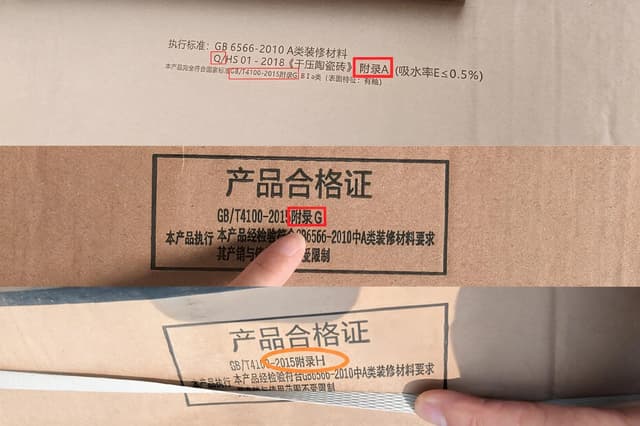
Verify that reports identify the relevant product and test method. Review label artwork, barcodes, language, carton quantity, shade and calibre information, pallet configuration and handling marks. Generic company certificates do not prove every model's performance.
8. Establish change control and quality checks
Agree how later production will remain connected to the approval:
- retained physical samples;
- shade and calibre controls;
- production and inspection records;
- test-report identification;
- batch and carton traceability;
- pre-shipment inspection;
- notification before changes to body, finish, packaging or process;
- claim evidence and response workflow.
Use the Tile Pre-Shipment Inspection Checklist to prepare the shipment review.
9. Pilot before expanding
Launch with selected dealers, projects or customer groups. Set a review period and track:
- sample requests and conversion;
- quotes and completed sales;
- sales velocity and gross margin;
- damage, returns and claims;
- installer feedback;
- repeated technical questions;
- stock-outs and replenishment time;
- which items substitute for each other.
Expand products that solve a clear customer problem and meet the commercial target. Revise or remove items that create duplication, weak margins or unresolved application risk.
Final assortment scorecard
| Area | Approval question |
|---|---|
| Demand | Is there evidence for the style, size, application and price? |
| Technical fit | Does the exact product match the intended use? |
| Compliance | Can current destination-market documents and labels be supplied? |
| Channel fit | Can dealers display, explain and reorder it? |
| Installation fit | Can local installers handle the product and system? |
| Logistics | Are weight, damage and handling risks manageable? |
| Margin | Does landed cost support the required channel economics? |
| Differentiation | Does the item add a useful role rather than duplicate stock? |
| Replenishment | Can lead time, batch variation and spare stock be managed? |
| Evidence | Are the sample, specification, report and inspection records connected? |
Frequently asked questions
How many tile designs should a new importer launch?
There is no universal number. Start with a range small enough to stock, display and explain properly, but broad enough to cover priority applications and price tiers. Expand using pilot evidence.
Should an importer choose porcelain only?
No. Build the range by customer and application. Porcelain is useful where its low absorption and complete specification fit; other ceramic products can serve suitable wall or floor applications.
Does CE marking make tile suitable worldwide?
No. CE marking belongs to the applicable European framework and declared performance process. Other countries and projects may require different standards, documents, labels and importer actions.
What should be sent to a factory before requesting a quote?
Send the destination market, application, required standard, product type, size, thickness, finish, quantity, packaging, target price level, required documents and delivery plan.
Build a range the market can buy and the business can support
Apply four filters to every proposed item: customer demand, application performance, market compliance and commercial feasibility. A product that passes all four is easier to sell, replenish and defend when buyers ask technical questions.
Join the discussion
Your email address will not be published. Required fields are marked.